Make money clipping
How to Make Money Clipping (Including Whop Content Rewards)
How clippers actually get paid across Whop Content Rewards, client retainers, TikTok, and YouTube Shorts—with real rates, fee math, platform traps, and a repeatable editing workflow.
By SupoClip · Updated · 12 min read

Every week, a new short-form video claims you can make $500 a day sitting on your phone cutting podcast clips on Whop. The screenshots are loud, the math is usually missing, and the comments are split between people who have actually cashed payouts and people whose last twenty uploads flatlined at 180 views.
Here is the honest version. Making money with clipping is real—brands, streamers, and podcasters spend millions every year turning long-form recordings into TikToks, Instagram Reels, and YouTube Shorts. What the hype leaves out is that clipping is piece-rate editing and distribution work, not passive income. The clippers who actually get paid treat it like a craft, understand how Whop Content Rewards and platform policies work, and eventually graduate from volatile per-view bounties into predictable client retainers.
The four real ways clippers make money
“Clipping” gets lumped into one bucket online, which is why beginners mix up incompatible advice. In practice, short-form clippers earn through four distinct models (plus owned affiliate funnels if you build a niche audience of your own). Each has completely different ceilings, entry bars, and failure modes:
Monetization map
How the five clipping income paths compare
| Model | Typical pay | Entry bar | Main catch |
|---|---|---|---|
Whop / Content Rewards (CPM) | $0.20–$5.00 / 1K views (median ~$1.00–$1.50) | No follower minimum | 10% creator fee on CPM/pool campaigns, per-clip caps, finite budgets, review rejections |
Direct creator retainers | $300–$1,000/mo freelance · $1,000–$3,000+/mo dedicated | Portfolio + outbound pitching | Fixed quotas, client revisions, and commercial tool licensing |
TikTok Creator Rewards | $0.40–$1.00+ / 1K qualified views | 10K followers · 100K views / 30d · 60s+ videos | Strict unoriginal-content enforcement; 5 flags in 30 days triggers disqualification |
YouTube Shorts ad share | $0.01–$0.07 / 1K views (up to ~$0.10–$0.33 Tier-1) | YPP: 1K subs + 10M Shorts views / 90d | 45% creator pool after music split; Reused Content blocks raw reposts even with permission |
Owned-page affiliates & funnels | 10%–40% commissions or sponsor fees | Consistent niche audience + buyer intent | Takes months to build; low-trust pages do not convert |
Notice the big split right away: Whop / Content Rewards lets you start with zero followers because a brand is paying you directly for distribution, whereas TikTok Creator Rewards and YouTube Shorts ad sharing require large audience thresholds and enforce strict originality rules that routinely disqualify third-party reposts. Meanwhile, direct client retainers pay the most reliably, because a podcast host pays you for delivered clips every month regardless of whether the algorithm gives a video 800 views or 800,000.
How Whop and Content Rewards actually work
If you searched how to make money clipping recently, you ran straight into “the Whop stuff.” Specifically, you saw Whop Content Rewards, which started as an app inside Whop and expanded into its own dedicated marketplace at contentrewards.com while still using Whop wallets and payment rails for creator payouts. Across its marketplace, Content Rewards reports more than $14 million paid out across hundreds of thousands of registered clippers and creators.
The premise is straightforward. Instead of a streamer or software company paying one influencer $10,000 upfront and hoping a sponsorship lands, they deposit a fixed budget (often $1,000 to $30,000+) into a campaign, upload raw podcasts, livestreams, or product footage, and set a rate per 1,000 verified views (CPM). Independent clippers cut vertical shorts, post them on their own TikTok, Instagram Reels, YouTube Shorts, or X accounts, and submit the URLs back to the dashboard.
Whop & Content Rewards mechanics
How a view turns into money in your Whop wallet
The four campaign formats you will see
- CPM (Cost Per 1,000 Views): The most common clipping format. Headline rates run roughly $0.20 to $5.00 per 1,000 approved views, with most active clipping campaigns clustering around $1.00 to $1.50 CPM. Face-to-camera UGC campaigns usually pay higher rates than pure repurposed podcast or stream clipping.
- Pool campaigns: A brand puts up a fixed prize pool split among approved clippers according to their share of total campaign views once the campaign closes and holds clear.
- Per-post bounties: Fixed payment for each approved clip that meets the brief, regardless of whether it goes viral.
- Retainer campaigns: Recurring monthly deals listed inside the marketplace for proven clippers who can hit a steady weekly quota.
Fees, holds, and payout windows you need to budget for
Three mechanical details catch almost every new clipper off guard:
- The 10% creator fee: On standard CPM and pool campaigns, Content Rewards deducts a 10% creator fee before your net earnings hit your Whop balance. (Per-post and retainer campaigns with budgets of $5,000 or more waive that creator fee.) Withdrawals from your Whop balance to a bank account or instant card can also carry standard transfer fees depending on the rail you pick.
- The 10-day earning and hold cycle: CPM clips typically earn in rounds—a 7-day earning window followed by a 3-day fraud and verification hold—and can continue accumulating paid views for up to 30 days after submission until they hit the clip cap or the budget empties.
- Finite, first-come budgets: Once a campaign's funded pool hits zero, tracking stops. If your clip is still sitting in the brand's review queue when the budget runs dry, those views will not pay out unless the brand tops up the campaign.
Six things to check in a Whop campaign brief before you cut a frame
A $3 CPM campaign that is 92% spent can empty while your clip sits in review. Prioritize campaigns with fresh pools or recurring refills.
If a campaign sets a $6 minimum payout at $3 CPM, every clip needs at least 2,000 views before it even enters review.
Many campaigns cap single clips at $100–$250 so one viral upload cannot drain the budget. Know the ceiling before you spend hours polishing one edit.
Higher-paying US/UK/CA campaigns often require a minimum share of Tier-1 viewers. Never fake location with a VPN—platforms flag and throttle it.
Required hashtags, tagged handles, clip length floor, banned watermarks, and no Instagram Collab posts. One missed rule voids the whole clip.
If 400 clippers already cut the same viral podcast segment, platform algorithms fingerprint duplicates and hold new uploads at 200 views.
One more reality check from active clipping communities: you do not control approvals. Campaign operators review submissions and run automated anti-bot scoring. Missing a required hashtag, leaving an editing-app watermark in the corner, posting an Instagram Collab when the brief forbids it, or getting heavily non-Tier-1 traffic on a US-targeted campaign are all routine reasons for rejection. Read the brief line by line before you open an editor, and spread your effort across two or three well-funded campaigns instead of betting your whole week on one operator.
What clipping actually pays (run your own numbers)
Industry analytics on live Content Rewards campaigns show why screenshots on social media are misleading: the median approved clip earns single-digit dollars, and most beginners earn roughly $50 to $400 a month while learning how to pick moments and hold retention. A small fraction of breakout clips carries the month—until they bump into the per-clip cap.
Switch between Whop / Content Rewards and Client Retainers below to compare what the math looks like after the 10% Content Rewards fee, per-clip caps, and your clipping tool cost:
Interactive calculator
Compare Whop CPM payouts vs. creator retainers
Adjust the sliders to your own assumptions. Includes Content Rewards' standard 10% creator fee on CPM campaigns and caps each clip at the campaign ceiling.
Count clips that actually clear review, not rejected drafts.
Views counted inside the campaign's tracking window (often up to 30 days).
Typical clipping campaigns sit between $0.50 and $2.00; median is near $1.00–$1.50.
Many campaigns cap individual clips at $100–$250. Set to 0 for uncapped.
Hosted SupoClip meters source video minutes. Solo clippers on authorized campaigns can also self-host for free.
Net after 10% fee
$312 gross · 65 clips · 260K views/mo
Net per clip
$4.80 gross before the 10% creator fee.
After hosted SupoClip
480 min fits Pro ($9.99/mo). Solo authorized clippers can also self-host.
Why averages flatter CPM clipping: Views follow a power law. Nineteen clips at 400 views and one breakout at 250,000 views average ~12,900 views—but at a $150 cap and $1.20 CPM, the breakout stops at $150 gross instead of $300, cutting the whole month roughly in half before the 10% fee.
Estimate only, before taxes and bank/instant withdrawal fees. Campaign budgets can run out before pending views settle.
Play with the cap slider for a minute and the structural lesson jumps off the screen. On open CPM campaigns, your downside is uncompensated editing hours and your upside is clipped by a $150–$250 cap per video. On a direct retainer, you trade lottery-ticket upside for predictable hourly pay—often $25 to $60+ per delivered clip before you even count performance bonuses.
Platform rules that kill payouts (and why accounts stall at 200 views)
New clippers often assume that if a podcaster or Whop campaign gives them permission to clip a show, they can double-dip by collecting Whop CPM payouts and joining YouTube Partner Program or TikTok Creator Rewards on the same page. Usually, that plan blows up within a month.
The reason is simple: copyright permission and platform originality are two separate tests. A Whop campaign authorizes you to use the footage so the creator will not DMCA-strike you. It does not make a lightly captioned repost “original content” in TikTok's or YouTube's eyes.
- 10,000+ followers and 100,000 authentic views in the last 30 days
- Only videos over 60 seconds qualify for RPM payouts
- At least 1,000 qualified For You views (5s+ watch time)
- Unedited podcast/stream reposts with only auto-captions or filters
- Third-party watermarks, static slideshows, Duets, and Stitches
- 5 unoriginal flags in a rolling 30-day window = full program removal
- 1,000 subscribers + 10M public Shorts views in 90 days (or 4,000 watch hours)
- 45% share of the Shorts Creator Pool allocated after music licensing
- Shorts must pass YouTube's channel-wide originality review
- Reused Content policy blocks aggregator and raw clipping channels
- Creator permission solves copyright—it does NOT waive Reused Content
- Low-effort compilations often lose both monetization and Shorts feed reach
- No follower count required on most open campaigns (18+ for payouts)
- Linked social accounts (Instagram usually needs Creator/Business mode)
- Submit URL promptly and clear the campaign's minimum view floor
- Bot views, engagement pods, or VPN geo-spoofing trigger fraud holds
- Brand holds final approval—strict adherence to tags, length, and tone
- If the pool empties while a clip is pending review, views stop paying
Why brand-new clipping accounts get stuck at 0–200 views
- Duplicate-clip fingerprinting: If a major podcast drops at noon and 300 clippers chop the exact same 40-second rant with the same crop and caption preset, TikTok and Instagram recognize the visual and audio hash and suppress late copies.
- Cold-account spam: Creating a fresh TikTok or Instagram account and dumping eight videos on day one looks indistinguishable from a bot farm. Spend a few days scrolling, watching niche content, and ramping up from one or two clean clips a day.
- The VPN geo-spoofing trap: Clippers outside the US sometimes try to force Tier-1 distribution with consumer VPNs. Platforms detect datacenter IPs quickly and routinely zero-view the account.
A repeatable clipping workflow (and where SupoClip fits)
Clipping only pays when your turnaround time is fast enough to make the hourly math work, without turning your exports into generic AI slop that gets skipped in two seconds. Split the job down the middle: let software handle transcription, first-pass candidate discovery, face-aware 9:16 cropping, and word-synced captions; keep moment selection, hook pacing, and final quality control human.
- You
- Pick fresh podcasts, interviews, or VODs with authorized rights
- SupoClip
- Imports YouTube, Twitch, and Kick links or uploaded recordings
- You
- Skip moments 300 others clipped; pick standalone claims and stories
- SupoClip
- Transcribes speech and scores hooks, engagement, value, shareability
- You
- Open on the tension in 2 seconds; cut right after the payoff
- SupoClip
- Face-aware 9:16 reframing, stacked webcam layout, studio trim & split
- You
- Fix proper names, match brief rules, keep subtitles clear of UI buttons
- SupoClip
- Word-synced animated captions, hook titles, dynamic edits, zero watermark
- You
- Submit links to Whop or clients; track retention and hook winners
- SupoClip
- Publishes or schedules to TikTok and YouTube; clean 9:16 export for Reels
1. Pick sources that are not already picked clean
In open Whop campaigns, speed and angle beat raw volume. Skip the single headline clip everyone already posted from the first five minutes of a podcast. Scan the middle and back half of two-hour episodes, Q&A segments, and full stream VODs where sharp stories and hot takes sit untouched. If you are clipping gaming streams, our GTA 6 clipping guide and Twitch VOD to Shorts walkthrough cover how to pair AI speech shortlists with manual timestamps for silent action.
2. Cut for a stranger in the first two seconds
Nobody scrolling TikTok or Reels knows who the guest is or what was said ten minutes ago. Cut straight into the tension, claim, or punchline—never leave “yeah, so I was telling my friend…” at the start. Trim stutters and dead air, keep only the context a stranger needs, and end immediately after the payoff so viewers loop instead of swiping early. See our checklist on finding the best moments in a long video.
3. Fix framing, captions, and safe zones—and never ship a watermark
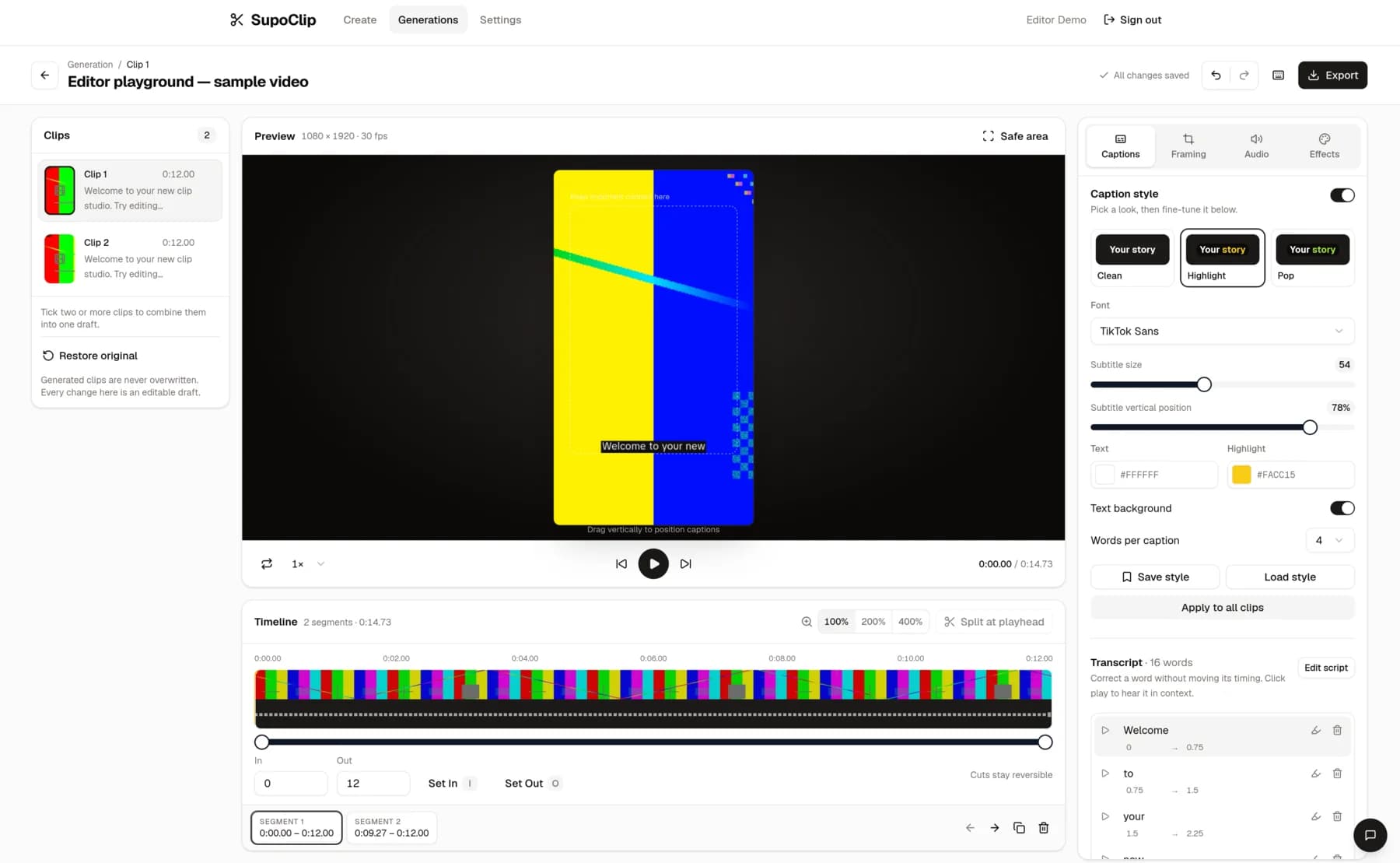
Most clipping campaigns instantly reject clips with third-party app watermarks, and automated captions still misspell guest names, brands, and slang. In SupoClip, every export is watermark-free on both hosted and self-hosted installs, face-aware reframing tracks speakers (or stacks a corner webcam above gameplay), and the built-in editor lets you fix misheard words, tweak caption styling, and check UI safe zones before rendering.
4. Cross-post cleanly and track what actually converts
One strong clip is an asset you can distribute across TikTok, YouTube Shorts, and Instagram Reels (as long as the campaign allows multi-platform submissions and you upload clean, non-watermarked files to each platform). On hosted SupoClip, you can publish directly to TikTok and YouTube together and schedule batches ahead on Creator, then download clean 9:16 exports for Reels. Keep a simple spreadsheet: campaign, source video, hook style, views at 48 hours, approval status, and net payout.
A transparent note on SupoClip's license for clippers
Before you choose between hosted SupoClip and self-hosting, check which bucket you are in under the SupoClip Noncommercial Source License:
- Solo clippers on Whop / Content Rewards: Participating as an individual creator in an Authorized Clipping Campaign and posting to your own channels is explicitly permitted on a free self-hosted SupoClip install (you only pay for your own compute and any cloud transcription/LLM keys, or run local Whisper + Ollama). If you prefer zero setup, hosted Pro ($9.99/mo for 10 hours) and Creator ($24.99/mo for 25 hours + scheduling) handle everything.
- Freelance client editors and clipping agencies: Cutting clips for paying clients, managing a client's channels, or running a multi-editor crew is commercial use. Use a hosted SupoClip plan (Pro, Creator, or Team) or email
support@supoclip.comfor written commercial self-hosting permission.
Moving from Whop bounties to $1,500+/month retainers
The smartest clippers treat Whop / Content Rewards as a paid training ground rather than the final destination. Open campaigns pay you to learn pacing, hooks, captions, and platform analytics while building a verifiable track record. Once you can consistently turn a one-hour recording into clips that hold viewers past the three-second mark, you hold a skill that podcasters, B2B founders, coaches, and streamers gladly pay monthly retainers to outsource.
Career ladder
How full-time clippers graduate out of open CPM bounties
Paid reps on Whop
- Join 2–3 well-funded campaigns in niches you actually watch
- Post 10–15 finished clips a week; track hook drop-off and approvals
- Save your top 5 clips and view screenshots as portfolio proof
First direct clients
- Find podcasters and B2B founders posting 1h+ YouTube videos with weak Shorts
- Send 2 unsolicited sample clips from their latest episode—not a cold pitch wall
- Offer 20–30 clips/month + captions + scheduling for a flat starter retainer
Retainers + performance upside
- Lock 2–3 recurring clients on $1,000–$2,000/mo retainers
- Add view-milestone bonuses or affiliate splits on products their clips sell
- Use a shared workspace (like SupoClip Team) if you hire a second editor
How to land your first retainer without spammy cold DMs
- Find creators with a distribution gap: Look for YouTube channels and video podcasts publishing weekly 45–120 minute episodes whose Shorts, TikTok, or Reels accounts are either empty or full of flat, unedited landscape crops.
- Lead with finished proof: Cut two genuinely strong 35–50 second clips from their newest episode, fix every caption word, and send private links alongside a two-sentence message—plus screenshots of your best Whop campaign view counts.
- Sell a clear monthly deliverable: For example, “24 vertical clips a month from your weekly episodes, custom-branded captions, hook titles, and scheduled posting to YouTube Shorts and TikTok for $1,000/month.” Once you prove consistency, add a bonus tier for clips crossing 100K views or a commission split on whatever the channel sells.
Want to see what a clean podcast-to-Shorts handoff looks like end to end? Read how to turn a video podcast into Shorts and Reels and how to style readable word-by-word captions.
Seven mistakes that keep clippers broke
- Chasing high CPMs on nearly empty budgets. A $4 CPM campaign with $80 left will drain before your clip clears review. Check remaining pool size and payout velocity first.
- Clipping the exact same moment as everyone else. If it was in the YouTube trailer or the first three minutes of a trending podcast, hundreds of clippers already uploaded it. Dig deeper into the recording.
- Shipping raw AI exports without watching them. AI gets you 80% of the way there in minutes; the last 20%—tightening the opening second, fixing misheard names, cutting dead air—is the difference between 250 views and 50,000.
- Ignoring one line in the campaign brief. Missing a mandatory hashtag, exporting with a watermark, or posting below the minimum length throws away views you already earned.
- Betting on TikTok or YouTube ad share for third-party reposts. Platform originality systems will eventually flag unoriginal aggregator pages. Keep native ad-share expectations for original or heavily transformative work.
- Trying to trick algorithms with fresh spam accounts or VPNs. Warm up accounts naturally, post consistently, and compete on watch time instead of hacks that trigger zero-view throttling.
- Stopping at clip #12. Short-form feeds take reps to calibrate. Track which hook styles and niches earn above-average retention across 30–50 uploads before deciding whether a niche works.
Sources
- Whop: Content Rewards overview
- Content Rewards marketplace (fees, payout cycles, and campaign formats)
- YouTube Help: YouTube Shorts monetization policies
- YouTube Help: Channel monetization policies (Reused Content)
- TikTok Support: Creator Rewards Program eligibility and originality rules
- SupoClip Noncommercial Source License (Authorized Clipping Campaigns)
Checked November 25, 2026. Campaign CPMs, platform fees, and monetization policies change frequently—confirm the current terms in each campaign brief and platform help center before relying on them.
Frequently asked questions
Can you actually make money with Whop clipping?
Yes, some clippers make consistent side income on Whop / Content Rewards, and a smaller group turns it into a full-time freelance or agency business. Expect piece-rate economics, not passive income: most open CPM campaigns pay around $1.00–$1.50 per 1,000 approved views minus a 10% platform fee, individual clips often hit payout caps, and beginners commonly earn $50–$400 a month while learning hooks and distribution.
What is the difference between Whop and Content Rewards?
Content Rewards started as an app inside Whop and expanded onto contentrewards.com while still settling payouts through Whop balances. When people talk about 'Whop clipping', they are usually referring to Content Rewards campaigns where brands, streamers, and podcasters fund a fixed budget and pay clippers per 1,000 verified views, per post, or on a retainer.
Do I need followers to start clipping on Whop?
Most open CPM clipping campaigns on Whop / Content Rewards do not require an existing follower count—you are paid on verified views per clip. You do need to be 18+ for payouts, link your social accounts (Instagram typically requires a Creator or Business account), and warm up fresh accounts like a normal user so TikTok or Reels does not throttle new uploads at zero views.
Why don't raw podcast or streamer clips qualify for YouTube Shorts or TikTok Creator Rewards?
Both platforms enforce strict originality rules. YouTube's Reused Content policy disqualifies channels that re-upload or lightly caption someone else's material—even if the original creator gave you permission. TikTok's Creator Rewards Program only pays on videos over 60 seconds and disqualifies accounts that rack up five unoriginal-content flags in a rolling 30-day window. Use Whop campaigns or direct client retainers when clipping third-party footage.
How much does a freelance clipper or clipping agency charge on retainer?
Market rates generally run $300–$1,000/month for entry-level freelance packages (around 10–20 clips a month), $1,000–$3,000/month for dedicated retainers delivering 20–90 finished clips with moment selection and captions, and $1,500–$6,500+/month for full-service podcast post-production and multi-platform publishing.
Can I self-host SupoClip for free if I am clipping for Whop campaigns?
Yes, if you are an individual creator posting to your own channels under an Authorized Clipping Campaign—SupoClip's Noncommercial Source License explicitly covers that under Permitted Monetized Use. If you clip for paying clients, manage someone else's channels, or run a clipping agency, use hosted SupoClip (Pro, Creator, or Team) or request written commercial permission.
Build a repeatable clipping pipeline
Paste a YouTube, Twitch, or Kick link—or upload a podcast recording. Let SupoClip transcribe, shortlist, reframe, and caption without watermarks so you can focus on hooks and distribution.
Keep reading
GTA 6 clipping
How to clip GTA 6
What clipping campaigns pay, Rockstar's rules, and the workflow from VOD to vertical clips.
ReadPodcast clips
Turn a video podcast into Shorts and Reels
Choose complete ideas, correct captions, and follow real clips back to the source.
ReadHighlight selection
Find the best moments in a long video
Use a practical checklist for hooks, context, payoff, and clean boundaries.
Read